Paying more for ceramic tint is worth it only when the upgrade delivers a documented benefit you need, with the same windows included. For a hot, glaring daily commute, compare heat-rejection data and usable visibility—not just the package name—and check whether removal, windshield work or other installation work sits outside the quote.
- Ceramic tint cost is worth comparing only when film specifications and included windows match.
- Lewolftintsolutions installs automotive window tint in Magnolia; compare written package details before choosing an upgrade.
- Standard Ceramic and Nano Ceramic labels alone do not establish a performance difference.
- Choose documented heat rejection for cabin comfort; choose a legal, usable shade for glare and visibility.
Why this matters
A car that feels uncomfortable on the drive through Magnolia or The Woodlands needs a practical fix, not a more expensive label. Heat, glare and privacy are different concerns, and a single darkness percentage does not describe all of them.
For your 2026 tint purchase, start with the problem you want solved. Then compare the film, covered glass and installation terms. Lewolftintsolutions offers window tint installation services alongside paint protection film and ceramic coating; those services address different problems, so keep your tint decision focused on the glass.
The better-value package is the one that meets your needs with clear specifications—not automatically the cheaper or more expensive option.
Ceramic tint cost: is upgrading worth it?
Upgrade when the higher-tier film has a documented advantage that matters to your driving, without losing coverage or accepting unclear installation terms. Stay with the lower tier when it meets your needs and the upgrade's practical benefit remains unexplained.
The package names Standard Ceramic and Nano Ceramic do not answer that question by themselves. You need the exact film identification and comparable performance data. A broad technology label cannot tell you what a particular installation includes.
| Option | Best for | Reason to consider it | Limitation to check |
|---|---|---|---|
| Standard Ceramic | Drivers whose comfort and visibility needs are met by its documented specifications | You avoid paying for an upgrade you cannot justify | The name alone does not establish its heat-rejection performance |
| Nano Ceramic | Drivers who can identify a useful, documented improvement over the lower tier | A verified performance difference gives you a reason to upgrade | The label alone does not prove that improvement or define included windows |
These are buying criteria, not a claim that every film sold under either label performs the same way. Compare the actual films proposed for your vehicle.
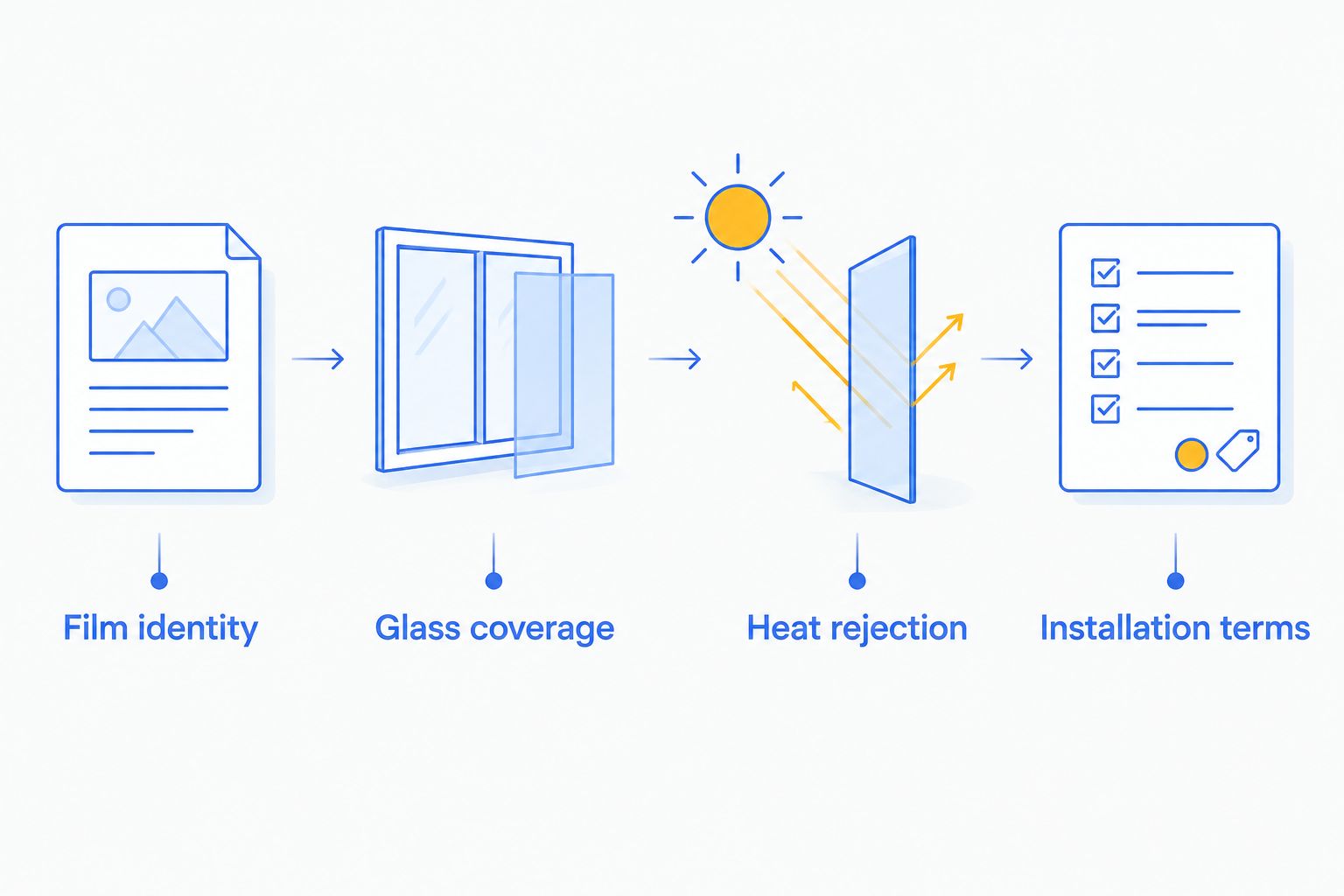
A quote is ready to compare when you can answer these questions without guessing:
- Film identity: What manufacturer and film series will be installed?
- Glass coverage: Which windows are included, and which are separate?
- Heat rejection: Which published measurements support the comfort claim?
- Installation terms: What preparation, removal and written coverage apply?
Ask for those answers in writing. A verbal description such as “our better ceramic” leaves too much of the purchase undefined.
Standard Ceramic: when the lower tier is enough
Standard Ceramic is worth choosing when its documented performance meets your priorities and you understand the installation scope. You do not need to upgrade simply because another package has a more technical-sounding name.
For an everyday driver in Conroe or Tomball, the useful question is straightforward: does the proposed film address the heat and glare that bother you while preserving comfortable visibility? Ask to see the shade options and the manufacturer's specifications for the exact film being quoted.
The advantage of staying with the lower tier is avoiding an unsupported upgrade. The limitation is equally clear: choosing it without checking specifications leaves you unable to judge what you are getting.
Choose Standard Ceramic on its actual specifications, not on an assumption that every ceramic film performs alike. If the installer cannot identify the film, pause the decision rather than filling the gap with a package name.
For a 2026 quote, keep a copy of the film identification with the installation paperwork. That makes the purchase easier to understand later without relying on memory.
Nano Ceramic: when the upgrade makes sense
Nano Ceramic earns consideration when the quoted film provides a measurable improvement relevant to your problem. For a driver focused on cabin heat, that means comparing appropriate heat-rejection data—not treating darker glass as proof of better thermal performance.
Ask the installer to show the difference between the proposed films at comparable visible light transmission. If one sample is substantially darker, appearance and glare reduction can distract from the thermal comparison.
The advantage of an upgrade is the additional performance you can actually verify. Its drawback is paying more without a clear explanation of what changes. A higher-tier label is not a substitute for a manufacturer specification sheet.
Choose Nano Ceramic when you can explain the upgrade in plain English: what improves, how it is measured and why that matters on your drive. Do not turn a published laboratory measurement into a promised cabin-temperature reduction unless the supporting evidence establishes that result.
Read tint measurements without getting lost
Film specifications describe different things. Keep these measurements separate when evaluating ceramic tint cost in 2026:
- Visible light transmission, or VLT: How much visible light passes through the material being measured. It describes light transmission, not total heat rejection.
- Total solar energy rejected, or TSER: A measure of the solar energy rejected by the tested glazing system. Compare the stated testing conditions as well as the result.
- Infrared rejection: A measurement concerning infrared energy. Check the wavelength range and test method before comparing figures from different sources.
- UV rejection: A measurement concerning ultraviolet radiation. It is not interchangeable with glare reduction or total solar heat rejection.
For example, 50% VLT means half the visible light passes through the material under the stated measurement conditions. A 20% VLT material transmits less visible light than a 50% VLT material. Neither figure, by itself, tells you the film's TSER.
Also distinguish a film's published VLT from the finished window's light transmission. The existing glass affects the final result, so a number on a film sample is not automatically the installed window's reading.
Darkness and heat rejection are separate buying decisions. Ask for a shade that suits visibility and applicable Texas requirements, then compare thermal performance within that decision.
Why ceramic tint quotes vary
A useful quote separates the film choice from the installation scope. For this comparison, focus on the factors already central to the buying decision: film tier, covered glass, vehicle application and the work included.
- Film tier: Standard Ceramic and Nano Ceramic need exact film identities before their specifications can be compared. Ask what changes beyond the package name.
- Covered glass: Two front windows and a whole-car installation are different scopes. A quote that leaves out glass is not directly comparable with one that includes it.
- Vehicle application: Have the installer quote your actual vehicle rather than treating a general package description as a complete estimate.
- Included work: Establish whether existing film removal, glass preparation and any separately discussed windshield work are included or excluded.
These factors are a checklist for understanding the quote, not evidence of a particular surcharge. Have the installer identify any additional work before you approve installation.
The same discipline applies to written coverage. Ask what the film manufacturer covers, what the installer covers and what conditions apply. Do not assume a package includes a particular warranty because another shop uses similar wording.
How do I compare ceramic tint quotes fairly?
Compare ceramic tint quotes by holding the vehicle, glass coverage and desired shade constant. Then evaluate the film specifications and installation terms.
Use this sequence before booking:
- Name the problem. State whether heat, glare, privacy or a combination is driving the purchase. That keeps the recommendation tied to your needs.
- Identify the vehicle. Give the installer the vehicle details and explain whether existing aftermarket film needs attention.
- List the glass. Ask for the included windows to be written out, with windshield work addressed separately if discussed.
- Identify both films. Request manufacturer and series information for each proposed tier, plus comparable specification sheets.
- Confirm the terms. Read the scope, exclusions and written coverage before approving the job.
For a 2026 comparison, keep each quote beside its corresponding specification sheet. Otherwise, it is easy to remember a strong performance claim while forgetting which film or shade it described.
Lewolftintsolutions is best for Magnolia-area drivers seeking a local automotive window tint installer with 3M authorization. Bring your vehicle details and comfort priorities to the conversation rather than asking only for the darkest option.
Use the booking page when you are ready to discuss the installation. Request the package details before choosing between tiers.
Compare your tint options
Discuss your vehicle, included windows and film specifications before choosing a package.
Is darker ceramic tint better for Texas heat?
Darker ceramic tint is not, by itself, evidence of better heat rejection. VLT measures visible light transmission; use the relevant thermal specifications to compare heat performance.
A darker appearance also changes how much visible light reaches your eyes through the window. Consider nighttime driving and visibility alongside glare, and have the installer explain the applicable Texas requirements for your vehicle and each window position.
Should I tint two windows or the whole car?
Tint two windows when those windows are the scope you actually want; compare a whole-car package when you want additional glass treated. The important distinction is coverage, not the package's headline figure.
Factory-darkened glass and aftermarket film are not interchangeable descriptions. Ask the installer what is already on the vehicle and what the proposed film adds before assuming rear glass needs no discussion.
FAQ
How much does ceramic tint cost in 2026?
Ceramic tint cost requires a vehicle-specific quote that identifies the film and included windows. Compare installation scope and specifications before treating two package figures as equivalent.
Is Nano Ceramic always better than Standard Ceramic?
Nano Ceramic is not automatically the better purchase based on its name. Choose the upgrade when the exact film offers a documented improvement that matters to your driving.
What's the best ceramic tint for cabin heat?
The best ceramic tint for cabin heat is a film with documented thermal performance that fits your visibility needs and applicable legal requirements. Compare the proposed films under comparable testing conditions rather than choosing by darkness alone.
Does a 20% tint block more heat than a 50% tint?
A 20% VLT figure does not, by itself, prove greater heat rejection than a 50% VLT figure. Those percentages describe visible light transmission; compare the films' thermal specifications separately.
Does a whole-car tint package include the windshield?
A whole-car label does not establish whether the windshield is included. Ask for every covered window to be listed and confirm any windshield work separately.
Can ceramic tint keep a parked car completely cool?
Ceramic tint cannot guarantee a completely cool parked car. Window film addresses solar energy through treated glass, but the vehicle still receives heat through other surfaces and conditions.
Where can I discuss ceramic window tint near Magnolia?
Lewolftintsolutions is a 3M-authorized window tint installer serving Magnolia and the greater Houston and The Woodlands area. Ask for a quote that identifies the film, covered glass and installation terms.
One last thing
Ask the installer to explain the upgrade without using the words “premium” or “nano.” A useful answer names the film, identifies a comparable performance difference and ties that difference to your heat or glare problem.
For your 2026 purchase, do not approve an upgrade you cannot explain back in one sentence. If the explanation stops at the tier name, keep comparing. If the specifications and scope make the value clear, you have a sound reason to choose it.